2026 Data Champion
Bryan Bellamy
Senior Data Science Analyst
Fort Worth, Texas, United States
We’ve been encouraged to ask questions, to explore how we might apply solutions from the private sector and municipal government, and I think that has allowed us to develop and implement really innovative ideas.
Why did you join your city government?
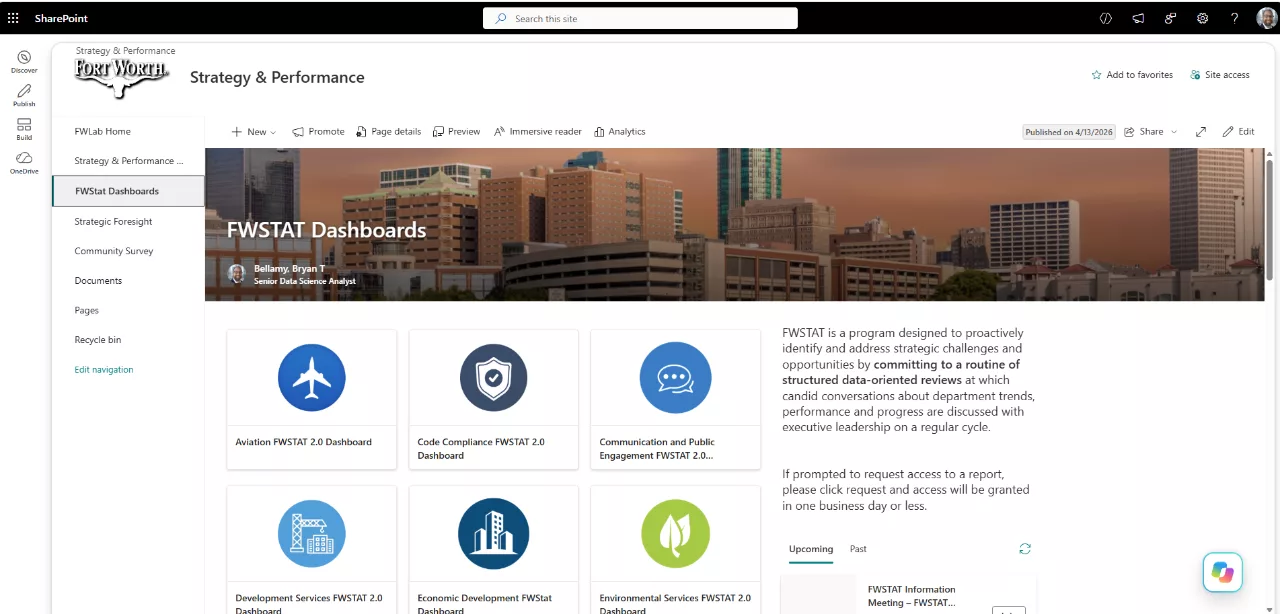
It was really the opportunity to work for the Fort Worth Lab. I had an opportunity to set up the Fort Worth Stat Strategy & Performance program, and implement something that I hope has improved the city. Fort Worth is the city that I was born and raised in, so for me this is more than just an act of public service, it’s truly an act of service. I have a unique set of gifts and skills, and the Fort Worth Lab has allowed me to use those skills to give something back to a city that has literally raised me.
What keeps you going on tough days?
The opportunity to make a difference. I’ve lived here for over 40 years and I feel like I know a good chunk of this city. It’s impactful to see the changes that have occurred and to know that in some small way I’m playing a part in the future of this city 40 years from now.
When you think of your city’s successful use of data, what are you most proud of?
The data governance framework that we developed over the past year. We had a team of about 15 committed data users from various departments come together over about three months to develop an enterprise-wide data governance program. It has set the standard for our future use of data here at the City of Fort Worth, and I’m really proud of what that group was able to accomplish in that short period of time.
Describe a specific problem you were trying to solve in your city. How did data guide your work and decision-making?
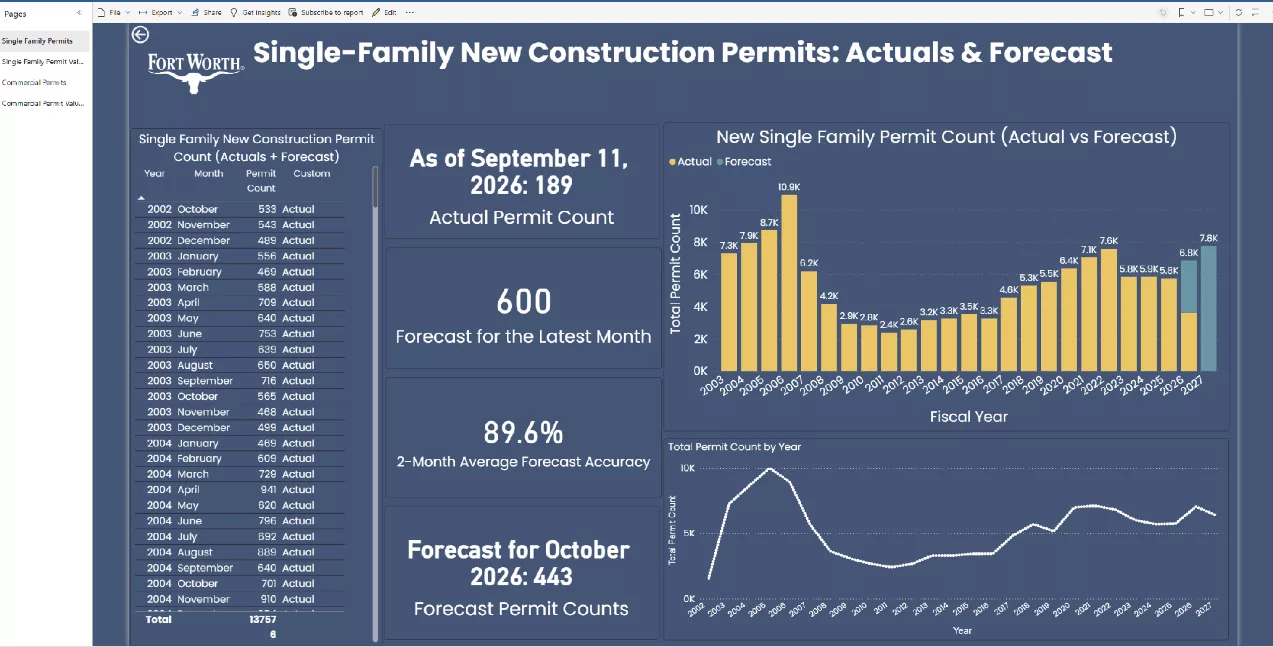
We were involved in a Development Services Department predictive modeling project. We had a core challenge of getting a clearer picture of future permitting activity so that the development services team could plan and allocate resources more effectively. Using more than two decades of permit history, along with some key economic indicators, the data analytics team that I’m a part of was able to build this machine learning model that can forecast permit volumes and construction validation trends. We were also able to develop this interactive dashboard that helps to make it easy to explore historical patterns, model outputs and performance metrics to support both the day-to-day operations as well as long-term planning. Overall, that project gave development services a data-driven foundation to understand growth trends and proactively prepare for future development across the city.
What would surprise people about your city government?
I’ve lived here for over 40 years now, and in that time, Fort Worth has nearly tripled in population. But even though it’s this extraordinarily large city, it is more proactive and community-focused than people realize. We have a lot of programs and unique partnerships to engage with residents and make our community better. For instance, we’re looking at launching a program called Engage Fort Worth. It’s a community academy that invites residents to learn how the City operates and get an understanding of what a city does and how it does it, so that they can go out and spread that news with their neighbors and their communities.
What lessons have you learned that other city leaders might find helpful?
One of the things that the Fort Worth Lab and the City of Fort Worth leadership have really fostered has been this pursuit of curiosity and pursuit of knowledge. This is my first time working in a municipal government, and I know that to be true for a lot of the folks that I work with here. We’ve been encouraged to ask questions, to explore how we might apply solutions from the private sector and municipal government, and I think that has allowed us to develop and implement really innovative ideas.
What did achieving What Works Cities Certification mean to you and your city?
What Works Cities has given us a blueprint on how to develop a data-driven culture within the City of Fort Worth, and it’s been at the heart of a number of things that we’re doing. It’s given us direction, areas to focus on and has provided us with educational resources and connections with other municipalities. What I really like about it is that it’s not entirely prescriptive, so it’s allowed us to adapt things to match our own culture, and as a result, people have been more willing to make changes.
What’s next for your work—and how do you hope to keep using data?
We are working on developing and implementing a program inventory, which we think will serve as a foundation for a lot of the work that the Fort Worth Lab does, and really the whole City of Fort Worth over the next couple of years. I think a lot of cities are moving in this direction, and we are really hopeful that this program inventory will provide us with a clear understanding of the key services we provide and help us to better align those services with our leadership’s vision for the future.
Where should people visit in Fort Worth?
There are some obvious recommendations: the Stockyards, the cultural district. We have some world-class museums here. The Fort Worth Zoo is one of the best in the nation. Our botanic gardens are absolutely beautiful. Magnolia Street has some really innovative restaurants. But for me, I think we have some amazing parks and trails all over the city that are tucked away, and are little respites from all the hustle and bustle of a major metropolitan area.