Philadelphia, Pennsylvania, USA
Housing Opportunities Made Easy (H.O.M.E.)
Project Type:
Economic Development, High-Performing Government, Housing
2025 Gold Certification
$2 billion housing strategy to be supported by $800 million in bond proceeds, approximately $1 billion in publicly owned land, and additional contributions from local, state, federal and other funding sources.
30,000 homes goal includes 13,500 new housing units and 16,500 preserved homes, for both renters and homeowners.
“Beyond public safety, there is no more pressing issue for Philadelphia than access to housing. This is an all-hands-on-deck moment for Philadelphia, and we are ready to act with urgency and transparency to deliver real results for our communities.”
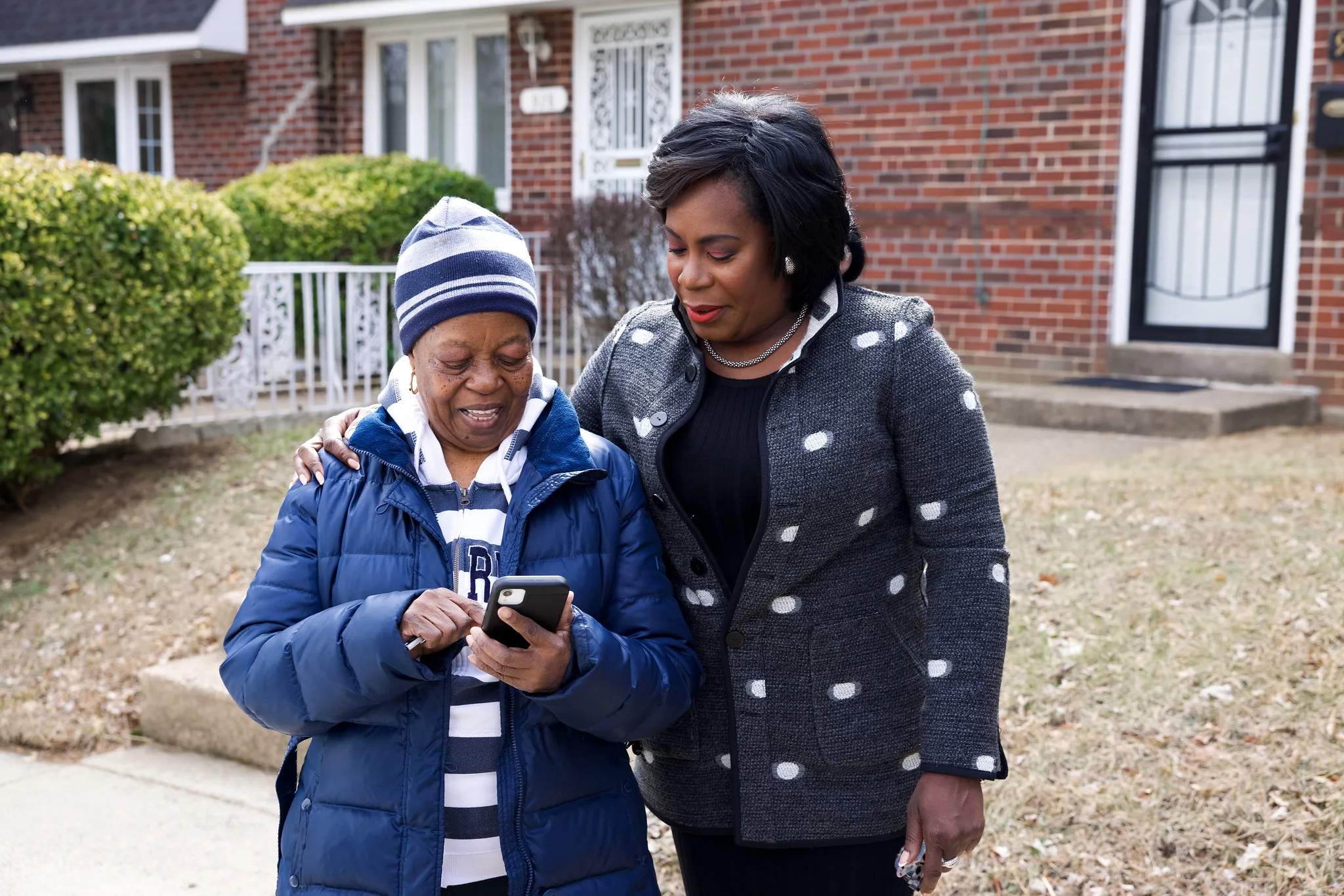
When Mayor Parker took office in January 2024, she made a bold commitment to create and preserve 30,000 housing units to help ensure every Philadelphian has access to a safe, quality and affordable home. As with other major Administration initiatives, the newly launched Office of Philly Stat 360 worked with the City’s housing experts to build a dashboard for the public to track progress and to help improve program and service delivery.
From the outset, sound housing policy and data-informed strategies were fundamental to success. The City researched best practices and conducted extensive stakeholder engagement to help shape the H.O.M.E. initiative, including creating an advisory group with a wide range of perspectives and expertise.
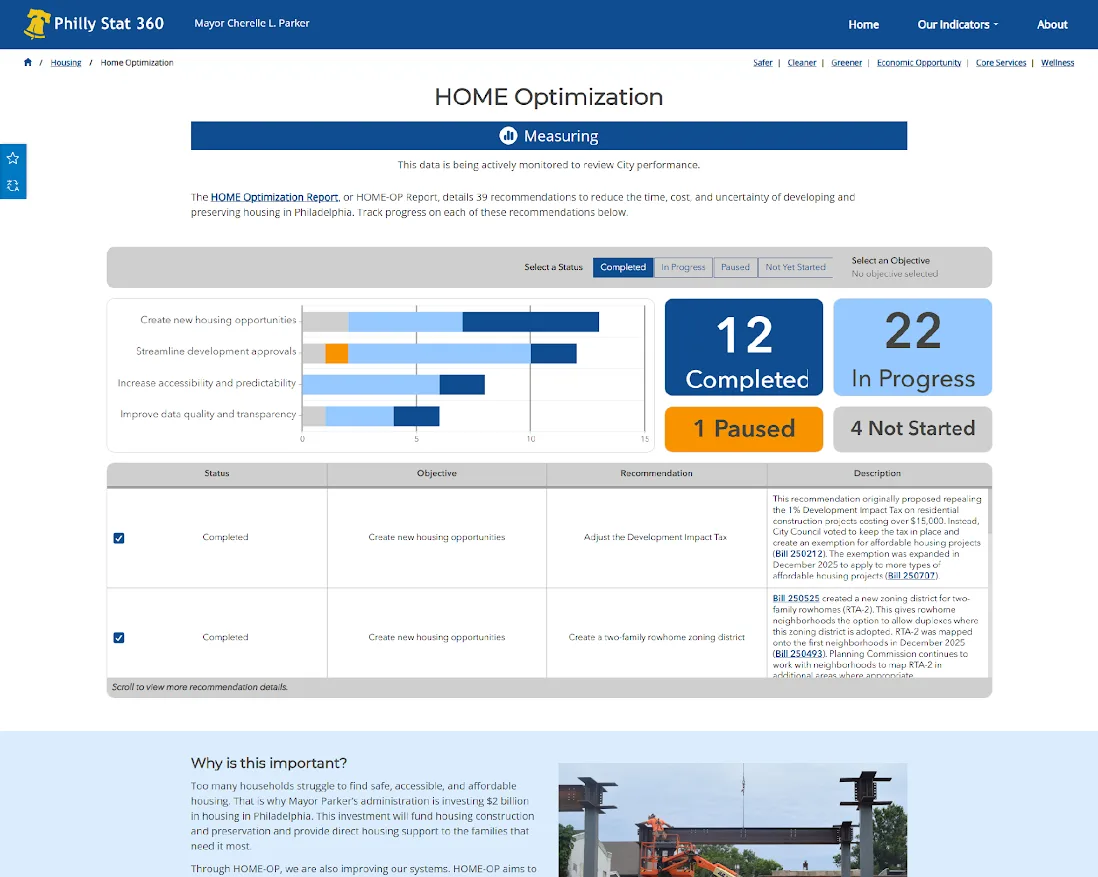
In early 2025, Mayor Parker signed an executive order establishing the H.O.M.E. initiative and advisory board. The executive order directed City departments to identify substantive improvements to approval and permitting processes that would reduce the ‘time tax’ on development. The Department of Planning and Development worked with the other departments to compile a report detailing recommendations to reduce the time, cost and uncertainty of developing and preserving housing. Through January 2026, 12 of the 39 recommendations have been completed and another 22 are in progress.
“Mayor Parker’s response to the City’s housing crisis isn’t based on political rhetoric or wishful thinking. The H.O.M.E. plan relies on a rigorous housing gap analysis conducted by industry leaders. We also looked at where development gets delayed within the City’s systems and came up with new policies and procedures to make development easier. I am excited to work alongside the Mayor and the City’s Department of Planning and Development to make buying, maintaining and preserving housing in Philadelphia more achievable for all residents.”
The H.O.M.E. Plan’s comprehensive data-informed approach to housing policy, process, programs and funding – implemented with collaboration across City departments and other partners – will ensure that more Philadelphians access safe, affordable housing and support healthier, more stable communities.
84 percent reduction in time for Zoning Board of Adjustment’s appeal decision issuance from a high of 78 days to a low of 12 days over a seven-month period.
28 new and existing programs to produce, preserve or stabilize housing.
2020 Silver Certification
Created an open data program that prioritized cross-departmental collaboration to secure the best possible outcomes for residents.
Helped the city save money and amplify the impact of its programs and services such as reducing litter, social rewards and school district meetings with teachers through the Philadelphia Behavioral Science Initiative.
Through a detailed and thoughtful analysis of the City’s homeless intake system to maximize efficiency and effectiveness.
Philadelphia’s Open Data Program
In a room adjacent to Mayor Jim Kenney’s office stands a long wooden table where he often holds meetings. He chooses to sit in the middle of the table, embodying his commitment to distributed leadership and collaborative problem-solving in the City of Philadelphia.
As the birthplace of American democracy, the City of Philadelphia is no newcomer to collaborative leadership. To find sustainable solutions that get results, the City pairs data-driven decision-making with efforts to ensure key stakeholders — from inside and outside City Hall — bring their varied perspectives to the task of solving local challenges. Whether it be city agencies, academic partners, or local businesses, everyone has a role to play in building a better city.
Philadelphia’s open data program is executed by the Office of Innovation and Technology CityGeo team. By using the department’s platform, Atlas, residents can easily access city data on permit history, licenses, and 311, and more; much of the data is also mapped via GIS. To open up an additional 300 data sets of information on both municipal and non-municipal data across the region, the City partnered with a local geospatial firm to build OpenDataPhilly. And the Open Budget section of the Philadelphia website shares how the City is spending taxpayer dollars alongside data visualizations that make the numbers digestible. To make the connection between innovation and city data more apparent, the City has collaborated with Temple University’s Department of Journalism to showcase the experiences of residents, from business owners to activists, who have used the City’s open data.
The City’s strong collaborative foundation has enabled it to incorporate data into nearly every aspect of governance. From silo-busting behavioral science initiatives to workforce development efforts, Philadelphia’s increasingly innovative programs are delivering better outcomes for residents — and opening up even more seats at the table.
Spreading Behavioral Insights
The results of the trial were so promising that Mayor Kenny and his administration established the Philadelphia Behavioral Science Initiative (PBSI) in 2016 to continue improving the City’s delivery of services. In 2017, PBSI grew to become a key branch of GovlabPHL, the City’s multi-agency team focused on bringing evidence-based and data-driven practices to city programs and initiatives through cross-sector collaboration.
Now when departments have a policy issue or a possible project, they are teamed with local academic researchers whose expertise matches the nature of the work. From there, the City and academics collaborate to determine the goals and the kind of data that will need to be collected, and to create a data-licensing agreement. The trials run through PBSI have already helped the City save money and amplify the impact of its programs and services, including reducing litter, as well as putting social rewards and identity salience to the test with school district teachers. Each year, the City of Philadelphia co-hosts an annual conference to generate new research partnerships and ideas.
The relationship through PBSI is a win-win for everyone, with the City working to better serve residents, while academics are able to test hypotheses that could turn into potentially publishable studies.
Improving City Service Delivery
The Office of Open Data and Digital Transformation (ODDT) believes in a City government that supports the success and well-being of all Philadelphians. ODDT is composed of a multi-disciplinary team who has deep expertise in design research, service design, content strategy, product design, and accessible technology development. With these comprehensive skill sets, the team partners with policy-makers, service providers, and the public to transform policy ideas into holistic and implementable solutions that meet people’s service delivery needs — improving how the government serves the public from an evidence-based design perspective.
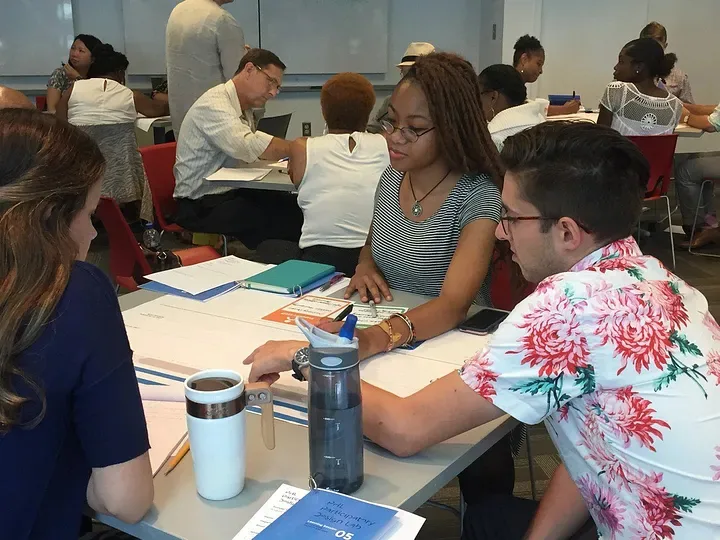
For example, through the City’s PHL Participatory Design Lab which is co-led by ODDT and funded by the Knight Cities Challenge, the City’s homeless intake system has become a learning lab for service design. Through a detailed and thoughtful process of journey mapping, identifying “pain points,” and soliciting input and feedback from those seeking services and staff who help them, the Lab identified two main areas for improvement. They are: 1) approaching information as a service, such as through transforming informational materials like signs, videos, and forms to better equip people with knowledge of what to expect, and through making the service delivery process more of a partnership and 2) improving physical space. Both ideas seek to improve the experience of people entering the homeless system and the experience of the staff working with them to maximize efficiency and effectiveness.
Supporting Local Business Owners
Another crucial community partner — local businesses — were once disadvantaged by outdated contracting laws. The City’s charter formerly required that contracts be awarded to the bidder with the lowest price, regardless of the contractor’s level of experience or other considerations. In May 2017, the City went to voters with a measure to award contracts based on factors such as expertise, quality, and experience to ensure that taxpayer dollars were leading to the best possible outcomes. Voters passed the new law to shift from “low-bid” to “best-value” procurement. The $25 million the City spends every year on food services — from after-school programs to feeding people experiencing homelessness — is one of the first areas the City is applying the new approach toward, teaming up with the Sunlight Foundation.
Philadelphia has since structured its RFPs around strategic goals and desired outcomes that can be measured through performance metrics. And to help leverage the expertise of previously overlooked vendors, the City has implemented a point system in its RFPs that rewards contractors on certain criteria; one of them is being a local business, helping the City work toward its goal of reinvesting more taxpayer dollars back into the local economy through vendors that were once priced out by less expensive options. The City is also prioritizing increasing the number of contracts with minority-owned and women-owned businesses.
Investing in the Future Generation
A focus on stronger collaboration between the city government and residents is also transforming the very composition of City Hall. Philadelphia yearns to build a government for its residents, by its residents. But when the City looked into employment data, the average age of a City employee was 45 years old, and Philadelphia’s diversity was hardly reflected in the government workforce.

The problem was not so much how to create talent, but how to get it into the pipeline. Part of the City’s workforce development strategy is designed to activate talent in the city and connect young people, communities of color, low-income neighborhoods, and formerly incarcerated individuals to family-sustaining jobs — and City government is ripe with these kinds of employment opportunities. In collaboration with ten city departments, the City as Model Employer program hopes to transition a minimum of 200 underserved individuals from temporary work into permanent employment by 2020.
While there’s still progress to be made, Philadelphia’s vision is clear: The future will be imagined around an inclusive table.