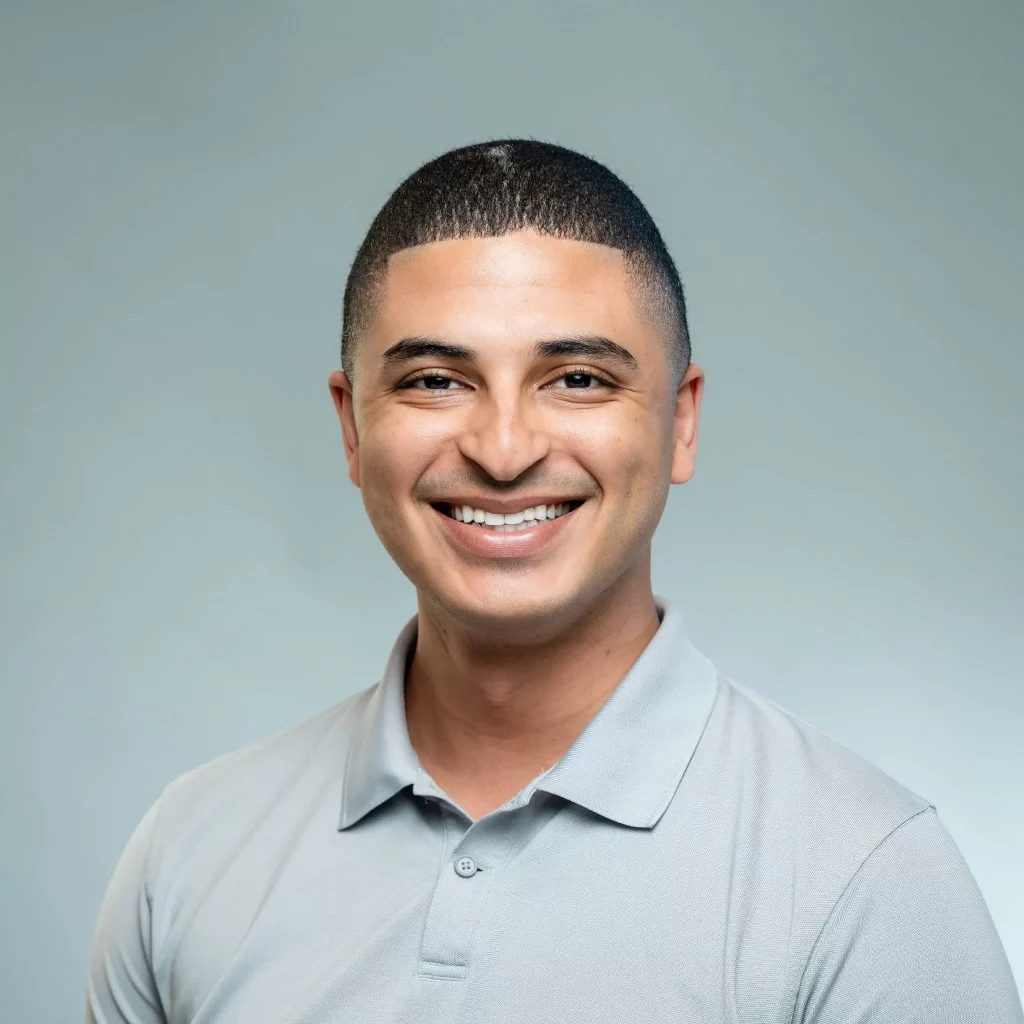
2026 Data Champion
Marlin McDaniel
Director of Innovation
Newport News, Virginia, USA
I love the challenge of trying to do more, do better, do faster for those that we’ve been entrusted to serve.
Why did you join your city government?
I was in county government, and my first foray into city government was here with the City of Newport News. One thing that really attracted me to Newport News in particular was the ambition and desire to do more for the community. It’s a community that’s been putting action behind words. The mayor and city manager have a bold ambition for what Newport News can deliver on. So it’s an exciting time to be a part of not only city government across the nation, but city government here in Newport News. I love the challenge of trying to do more, do better, do faster for those that we’ve been entrusted to serve.
When you think of your city’s successful use of data, what are you most proud of?
I’m proud of the intentionality in which folks were leveraging data prior to me joining here and how we’re building on those bright spots of innovation. For example, there are staff across several departments, who have been attempting to use data to create management dashboards or leadership insights, and we really get to support those individuals in bringing their ideas to fruition, and providing them with the infrastructure they need. There are short-term wins and there are the longer-term objectives. We are developing a greater appreciation for the AI space in particular, which gets a lot of folks excited. AI readiness doesn’t start without data readiness, and having clean, quality, governable, secure data assets that we can make available to AI tools is becoming increasingly more important because you know what we provide to AI can either run off the rails or it can actually produce useful results.
Describe a specific problem you were trying to solve in your city. How did data guide your work and decision-making?
Our mayor cares deeply about how we are serving and preparing our youth to thrive here in the community, and as part of that we conducted an evaluation of our Friday Night Nets program — a free recreational program available after hours on Friday nights in the summer to provide youth a third place where they can have fun, connect with friends, stay off the streets and engage in pro-social activities. One of the challenges we were trying to work through was whether the program was achieving the outcomes that it was set out to accomplish, particularly violence prevention and intervention. We could certainly articulate very quickly how many kids were coming in the door, how many partners were participating and connecting with youth, but we wanted to better understand: Are we reaching the right audience? Answering that entailed not only an evaluation of the available data, but implementing new data systems to understand how we were addressing that problem. Through this effort, we learned that while we were reaching many youth, we weren’t necessarily reaching the youth that might be most likely to be either victims of crime or perpetrators of crime. That analysis allowed us to secure about $750,000 of additional funding from the federal government to better position the program to reach target youth. I’m really excited to see how the funding will help to not only serve the kids coming in and enjoying the program, but also those that could benefit from third spaces and wraparound support.
What lessons have you learned that other city leaders might find helpful?
Be curious with data and don’t necessarily get stuck on the first question. We oftentimes can get stuck in the trap of wanting one specific question answered, but as we see what data is telling us, we have to be open to letting it lead us towards the more practical questions that we can address. When we worked on Friday Night Nets, our questions evolved based on new information. We wanted to know, “Is crime going down?” That was a tough nut to crack based on the information we had available or could reasonably collect. We didn’t let perfect get in the way of the good, so we landed at trying to answer the question of, are we bringing in those highest risk individuals? That was an expedient and practical question that we were able to address, and ultimately secure additional funding. We didn’t arrive at a nicely buttoned up conclusion on the Friday Night Nets program’s effect of violence, there were other ways we showed leadership how we could leverage data to enhance services to the community.
What did achieving What Works Cities Certification mean to you and your city?
Giving staff the recognition they deserve and have earned was first and foremost the most rewarding aspect of it for me. It demonstrates that staff are working with a level of sophistication and data maturity that Bloomberg Philanthropies and Results for America consider best practices. Our motto is that we’re built on breakthroughs, and our mayor would be the first to say that Newport News should be at the same tables as New York City and Boston and L.A. or Chicago. We have fewer resources and a smaller population, but staff run our government with the same level of sophistication and intentionality as bigger players in the space. Demonstrating through What Works Cities and the Certification process that we are building and have built best practices is certainly rewarding.
What’s next for your work—and how do you hope to keep using data?
A big piece of this is continuing to support the workforce, both those who already have strong ambitions around how they want to use data, and those who might not see data as immediately present in their roles. Many staff members are creating data through their day-to-day work. Whether it’s a facilities management worker completing a work ticket, or an HR staff member closing out a job posting, they are producing data that could be great quality or it could be poor quality, depending on how much they see their connection as staff members to the “why” behind the data. I’m looking forward to a lot more co-creation of data literacy work and upskilling, particularly to leverage AI for routine tasks where human time can be better spent on the creative challenges.
Where should people visit in Newport News?
I don’t think Newport News is fully appreciated for its outdoor recreation. Newport News Park is the largest municipal park this side of the Mississippi in the United States. There is hiking, boating, fishing, or even just getting lost in the park physically or metaphorically. Newport News is also a place where you could venture from the past to the present to the future. Our Mariners Museum has Confederate battleships. We also have a particle accelerator, Jefferson Lab, that is advancing scientific discoveries. Newport News is a place built on breakthroughs, and you could see and experience all of that just in one day, if you’re not lost in Newport News Park.